
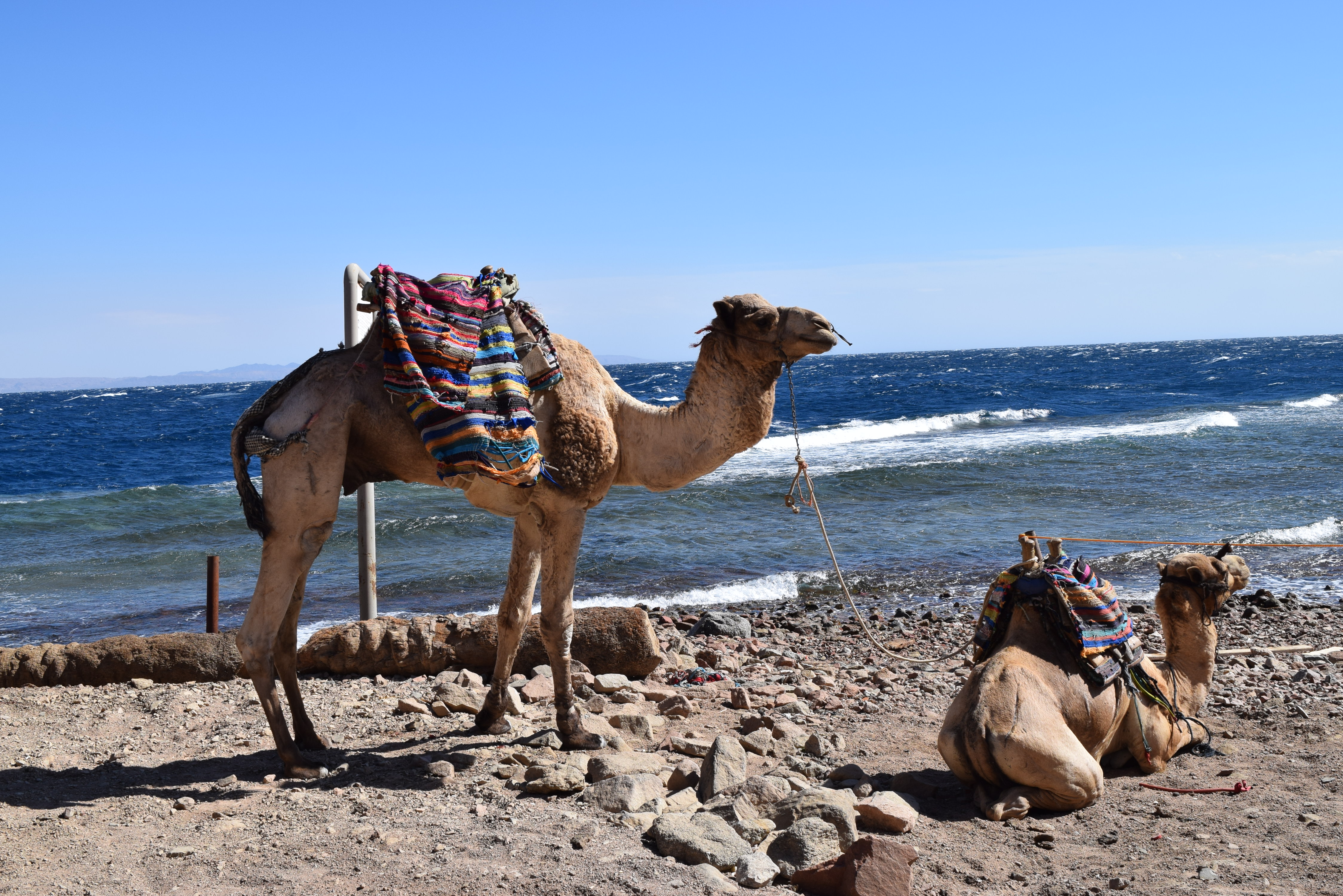
From now on, camels are officially off my Christmas card list. No longer will I be seduced by fluttering eyelashes and romanticised images of ships of the desert gently plodding along in front of pyramids; down wadis, and through desert dunes with saddle blankets hand made by Bedouins.
No, I’m done. Camels: you and I are officially OVER.
When anyone tells you that the hardest part of the whole ‘staying on the camel’ thing is when it stands up or sits down, don’t believe them! If you are going to fall off, this is probably the best time to do it. You can do a kind of graceful feet first slide off the back or indeed a feet first slide down the side. Even if you are unfortunate enough to perform a bottom or shoulder first topple, then you’re stationary and the chances are there’s a guy holding the reins and trying to help you stay on as the beast gets up.
I’m typing this now, back at home (actually on ‘hump day’ – can you believe the irony of that?!), and I realise I don’t really know what happened. Other than I was on a camel, and other than I came off it.
What could be more romantic and a true desert experience than a camel ride? I had journeyed from Sharm El-Sheikh in Egypt to the Coloured Canyon in Nuweiba and was going back to Sharm via the Blue Hole near Dahab where there was an opportunity to ride a camel along the beach road back to the jeep. Not exactly ‘through the desert’, but near enough.
Things started well. I looked at my camel and he/she looked at me, fluttering those big eyelashes and gently bobbing his/her head towards his/her back as if inviting me on. I managed a graceful reverse grand rond de jambe en l’air (slung my leg over the back of the camel), and was seated comfortably on the saddle and maintained balance as the camel got up from the ground back-legs-first.
There were four camels in our train, and we plodded gently along the stony coastline. I held on tight to the pommel of the saddle whilst taking a few snaps, learning with every step to follow the gait of the camel and relax into the gentle movement.

As we rounded the headland I could see the jeep in the distance. I know it sounds ridiculous to say it, but I remember having a really uneasy feeling and asking how much further there was to go. Maybe this should have been a warning sign? Maybe I sensed my camel had just had enough of endless treks back and forth carrying overweight, unskilled at camel riding tourists slung with cameras? Maybe I sensed it was rutting season and he got the scent of a pretty woman? I don’t mean me; that would be wrong. I mean a pretty lady camel.
What I remember about what happened next, and what actually happened next are, most likely, not one and the same.
It took a few hours to even remember I was on a camel. In my memory, the camel reared up and I thought ‘I’m not going to be able to stay on this camel it’s going to throw me off’. That’s exactly and truthfully what I still remember six days later. What makes me doubt this ‘memory’ is someone I know who used to live in the Middle East told me camels don’t rear up. Even with this knowledge, this is still what my brain is telling me happened. I’m not sure it helps knowing that what I remember might not be real, I suppose it just shows the level of trauma my head has suffered, as the memory feels very real indeed.
Anyway, back to Dahab and the first memory I have that I trust is that there are ambulance guys pouring water in my mouth and eyes, which are caked with sand and grit. The next thing I’m aware of is being in the back of the ambulance wearing a neck brace.
Flitting in and out of consciousness, I’m taken to a local government hospital somewhere in Dahab where the walls in the corridors and the consulting room are all an ancient dark green and the doctors do not speak English.
I was held upright in a chair while they used something (a razor? scissors?) to cut my hair and then sew 7 stitches into my head, all the while flies were landing on my face and the pressure on my neck where they were just touching the top of my head was the biggest pain I’ve ever felt.
The guide who was with me was my English translator. He told me they wanted to send me to another hospital 200km north for a CT scan because I’d lost consciousness and because of the obvious pain in my neck.
I was already 100km north of Sharm El-Sheikh, and I was due to fly home at 4am the next morning. My friend Sarah was waiting for me in Sharm – all I wanted to do was get back there. Could they send me there instead? Well, they said no. I guess thinking back, they wanted to keep a lucrative foreign patient with travel insurance in their own district under government care. They also told me the phone wasn’t working, and therefore there was no telephone number I could give to my insurance company for the ‘doctor’ that had seen me.
The English speaking guide told me that I could pay 300 Egyptian Pounds for a taxi to take me to a private hospital in Sharm where there was a CT scanner, or wait an hour and a half for a bus. He seemed to want me to discharge myself against doctor’s advice and get back to Sharm immediately by any means. Maybe his dinner was already in the oven? Maybe he didn’t want to miss his fave TV show? Maybe he was on a promise? Whatever it was, Dahab was definitely not where he wanted to be either.
At this point, I was hooked up to a drip lying on a trolley in the hospital corridor with flies buzzing around me. I couldn’t stand, sit, or lie down unaided. He told me the ambulance could take me to a hospital in Sharm, but it would cost me 500 Egyptian Pounds (about £45). I pointed at my rucksack and handed over the cash, not caring if the promised receipt ever arrived. As I did so, the porter waiting to wheel my trolley lit up a cigarette and a cat nonchalantly walked down the corridor.
I would class myself as reasonably independent and fairly self-motivating, but at that moment; concussed, in the most pain I’ve ever been in, alone and upset; this hospital was the last place on earth I wanted to be, and the only person I wanted to see was Nigel.
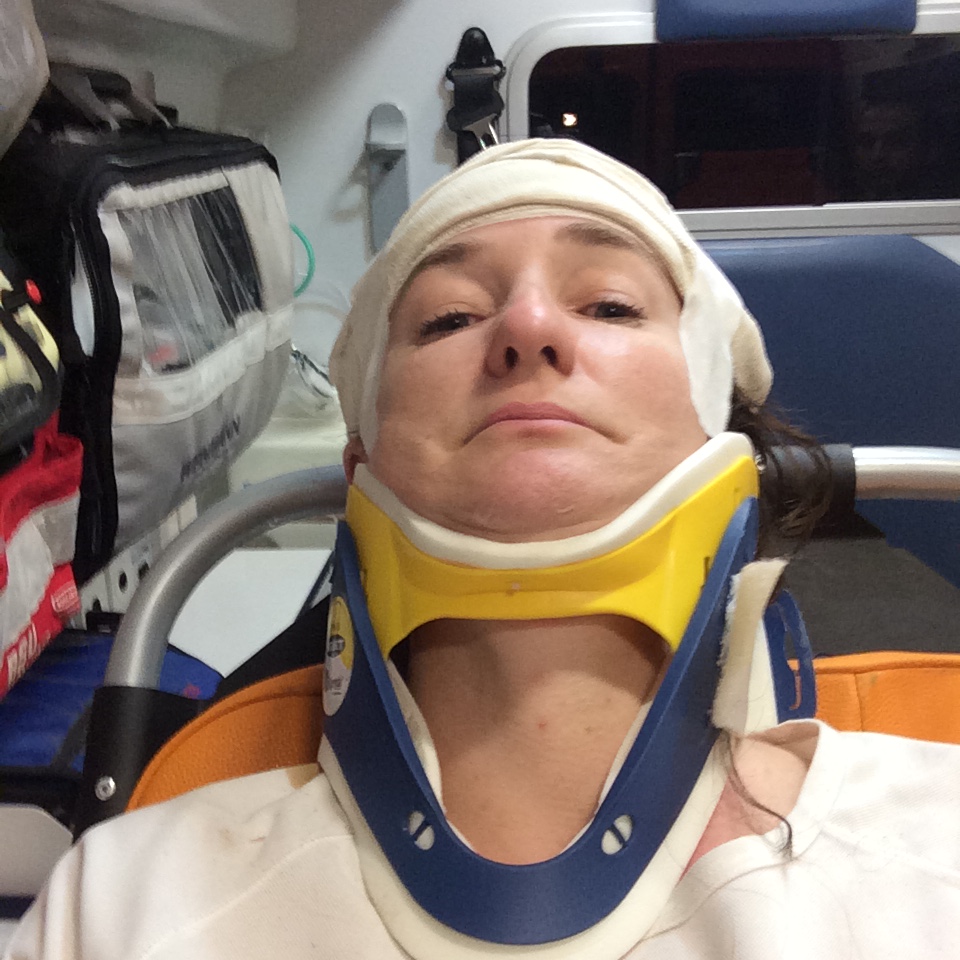
Rocking the neck brace and head bandage look.
There are some things that stick in my mind about the hour’s journey in the ambulance back to Sharm El-Sheikh. I remember wishing I’d taken a picture of the cat in the corridor, and I remember taking a picture inside the ambulance. I remember the drip finishing and the ambulance crew dropping it before it was disconnected from the catheter in the back of my hand. I remember stopping at checkpoints; soldiers looking into the back of the ambulance to check this wasn’t a hoax to disrupt the Economic summit taking place in Sharm. I remember arriving and being wheeled into another, more sanitary, world of bright lights clean rooms and English speaking doctors.
I have been amazingly lucky. I have 7 stitches in my head, a very very sore neck being supported by a collar, a shoulder and arm I can’t move, bruises all over my legs, scraped and swollen knees, but miraculously nothing broken. Nothing.
This brings me back to the fall and why I’m still worried – I don’t remember falling. I have a bruise on my left index finger knuckle and a scrape on my right hand at the bottom of my index finger. My hands did not break my fall. From my injuries, my knees and my head broke my fall which makes it seem as though I’d blacked out before I left the saddle. I don’t know why and I probably never will.
Here is what I’m thankful for:
Travel Insurance. I’m still waiting in the hope that my hospital bills, rearranged missed flight, broken camera and £140 of overseas mobile bill will be covered, but I was still grateful to talk to an English speaking nurse at my darkest point in the first hospital.
Having such a thick head. It could have been so much worse.
Fabulous friends. Lovely friends who have made camel jokes, brought me dinner over every day because I’m unfortunate enough to be home alone this week, cooked me a chicken, bathed my stitched head in antiseptic, done my grocery shopping, topped up my mobile phone because the ‘packet’ expired, changed the cat litter tray, emptied the bin, done my washing, brought me cake, made me brownies, sent me a curry doggie bag because I couldn’t make a dinner party, brought me flowers (and trees!), collected my post, sent messages, made their own tea and then sat with me while I’ve not been able to keep my emotions in check and been patient when I’ve hunted for the words to finish my sentences which just won’t come.
Here is what I would do differently if I could relive the day:
Nothing. I’d still get on the camel. Travel is about experiencing and not always watching from the sidelines.
Here is what I will do differently next time:
I’ll pass on the camel ride, thanks. Been there, done that, fallen off and was lucky enough to walk away. Albeit in an ambulance.
I’d still get on it the first time, but the second time? No, once is enough for this girl. Travel is also about learning, and knowing when you are beat. This time, the camel definitely won.

 Two Nomadic Brits