
It’s hard not to wonder why I don’t remember much from the late 1980’s early 1990’s about what was going on in Eastern Europe, when people were laying down their lives for freedom from Communism and campaigning for what we in the ‘West’ often take for granted.
I do remember watching reports on TV, and the names of toppled dictators in the countries we have visited over the last twelve months are familiar but I didn’t have any real sense of the plight of the people.
Just as the Balkan Way stirred me to tears when we visited Riga, so the struggle of the Romanian people before and after Ceauşescu is something that grapples with emotions and conscience.
As we came in to land at Bucharest Băneasa airport, which although the second airport is actually closer to the city centre, I was shocked to see a housing estate being built literally next to the runway, not just close by, but with the houses a mere 100 meters or so from the landing aircraft and separated by a flimsy chicken-wire fence. Is this capital city really so short of real estate?
We had been warned by the LP that the taxi drivers of Bucharest were a somewhat unsavoury crew. As we left the airport we had hoped to see the bus station, or at least see a sign for the bus station. No. No sign of anything remotely resembling a bus, just a yellow sea of taxi cabs and their scowling surly drivers shouting to get our attention and business into the city centre.
What everything I had read (including the official airport website) failed to mention was that the bus to the city centre actually left from a shack that is across the dual carriageway that passes the airport and that the buses do not stop at the airport itself. Nige thought he could ask the taxi drivers the way to the bus station, and really and truly any taxi driver in any country would probably be hacked off by this, but it was particularly scary when once the guy realised we had no intention of getting in his cab started shouting and ranting at us in a loud voice. I do worry about my husband sometimes – why he thought the cabbies would be happy to help point us in the direction of a cheaper fare into town I don’t know.
I had been unsuccessful in finding hostel accommodation in the city – those that were available were more expensive than the budget hotels, and were much further out from the city centre. I had therefore booked into the jolly sounding ‘Hello Hotel’ which was a budget offering close to the main rail terminus; an area described by LP as ‘seedy’. The room was perfectly adequate, and looked out onto a crop of soviet era run down apartment blocks. This was fine by me, as it wasn’t facing the road and therefore I thought it would be a whole lot less noisy – and it probably was; save for the barking dogs and the screech of car tires in the early hours.
I loved Bucharest. Not because it was particularly beautiful, or exciting, but because it represented the continuing struggle of a repressed people still striving to emerge from the darkness.
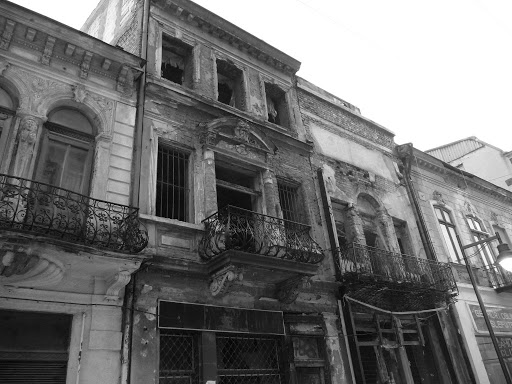 It was safe – no matter where we were; day or night, I felt safe. I think Bucharest gets a bit of a bad press in this respect, that it does not entirely deserve. In fact, Bucharest was probably better at night – simply because at night the wear and tear is hidden, and the people came out to play. Bars and restaurants that during the day were deserted were full of life at night, and the buildings beyond repair and desperately sad during the day were subtly lit at night to hide the blemishes.
On our second day, we took what was to be both the highlight and lowlight of the weekend – a tour of the Parliament Palace. This building is the second largest government building in the world (only the Pentagon is bigger), and was commissioned by Ceauşescu in 1984 – and paid for at the expense of the Romanian people. The building is obscene, beautiful, extravagant, ostentatious, and the ultimate expression of an individual’s megalomania and the love of himself symbolising the sacrifices of the Romanian people during this time.
 For the first 20 minutes of the tour, I was utterly outraged at this man who could use the country’s money to produce such an outrageous display of wealth while his people were starving and suffering under his corrupt regime. Then, listening to the twentysomething tour guide explain the dilemma for the people after Ceauşescu was deposed of what to do with the unfinished white elephant I began to get another sense of the strength of these people. Millions of Romanian Leu were squandered on this building. Tearing it down would not get the money back, however slowly finishing it (and it’s still only 95% finished) and putting it to use could be seen as a testament to the strength of the people rather than the corrupt regime it could so easily have represented.
I began to see the building in a different light. Every single hour of labour and piece of stone, marble, cloth and metal used to make the building comes from somewhere within Romania. It’s a testament to local craftsmanship, and symbolic of the natural resources of Romania, but more importantly, it symbolises the rise of the people over oppression and tyranny. Whilst my anger at the reasons for starting it never waned, my admiration for the reasons for finishing and retaining it grew exponentially.
It’s a hard life still – but Bucharest is getting there. It’s rising from the troubles of the past and settling in to a position in Europe and as a participating member of NATO. An incredible journey.


 Two Nomadic Brits